
Finding Focus:
Which will help you more -
Sukha or a Focus Music App?
OR, IS 80'S GANGSTA RAP HELPING ME?
Focus music became its own category once neuroscience-backed playlists started showing real results.
Also: yes.
The short answer
If you're looking for focus, the real question isn't if music helps; it's what other ingredients will supercharge your flow.Your choice is whether
a single-feature focus app (like music players)
or
a fully-featured flow state app will help you more.
What's more fun than a list? Here ya go.
Category one
Single-feature Focus Apps…
Focus Music App Features:
- plays background focus music
If this is all you need, a free Spotify focus playlist does the same job - why pay for it?
Category two
Complete Flow State Apps…
Features:
- Flow Music
- Phone/Website Blocker
- Pomodoro Timer w/Healthy Breaks
- Simple Task Manager
- Productivity Metrics
- AI Coach to break down tasks
- Coworking Rooms
- Gamification for encouragement
These apps engineer the whole Flow State for you.
Having a clear task, a quiet environment, focus music, AI support — is the full set of conditions to get you in The Zone.
Sukha is in this category.
The long answer
Reading this website is just procrastination - we both know that.
I'm in The Zone?
Yeah, and you can make cake without flour or chocolate, but you'd be missing out.
Focus music apps supply the right soundtrack. Brain.fm builds tracks around modulation patterns tied to sustained attention, and Endel adapts its soundscape to the time of day and your movement — that can genuinely help you settle in.But changing what you hear is only one lever. Your phone still buzzes, the browser tab is still one click away, and nothing here plans your work or gets you back on track when you drift.
Deep, deep nerd alert. You were warned.
The idea that music is a magic shortcut to a “flow state” is incredibly popular, but psychological research consistently shows that auditory input alone is structurally insufficient to induce true flow.
According to Mihaly Csikszentmihalyi's foundational Condition-Experience Model, flow is not just an emotional mood or a state of relaxation; it is an active state of cognitive architecture that requires specific task-based parameters to unlock (Moral-Bofill et al., 2023).

1. The Task-Dependency Study
A recent study explored how self-selected vs. generic music interacted with task performance to alter neural and physiological markers of flow (Bartling, 2026).
The Setup: Researchers placed participants in a simulated task environment under different music conditions paired with varying levels of task difficulty.
The Finding: While listening to great music generated robust physiological responses (like changes in heart rate variability and arousal), the music conditions alone did not significantly trigger a self-reported psychological flow state. Instead, flow only emerged when the music was paired with an optimized task difficulty level that demanded high cognitive resource allocation and minimized task-switching.
The Takeaway: Music can optimize your physiological baseline (reducing boredom or masking background noise), but without an active, engaging task that demands your skills, it cannot cross the threshold into true flow.

2. The Predictor Model Study
To understand what actually causes flow, a study published in Frontiers in Psychology used logistic regression to analyze which variables actually predict whether someone enters a high flow state (Moral-Bofill et al., 2023).
The Finding: The study confirmed that structural task conditions, specifically a perfect challenge-skill balance, clear goals, and immediate feedback, accounted for the vast majority of the variance in achieving flow. Environmental triggers or the medium itself (such as the presence of music) had minimal predictive power on their own.
The Takeaway: You can play the perfect playlist, but if your current task lacks clear, immediate goals or is either way too easy (causing boredom) or way too hard (causing anxiety), a flow state is mathematically and psychologically improbable.
The Analogy: Think of music as the oil in an engine, not the fuel. It lowers the cognitive friction of your environment, but the actual “fuel” that drives the flow state is the structural design of the work you are doing and the whole environment you create for your work.
So what is Sukha exactly?
A website you run in the background while you work. Nothing to install.
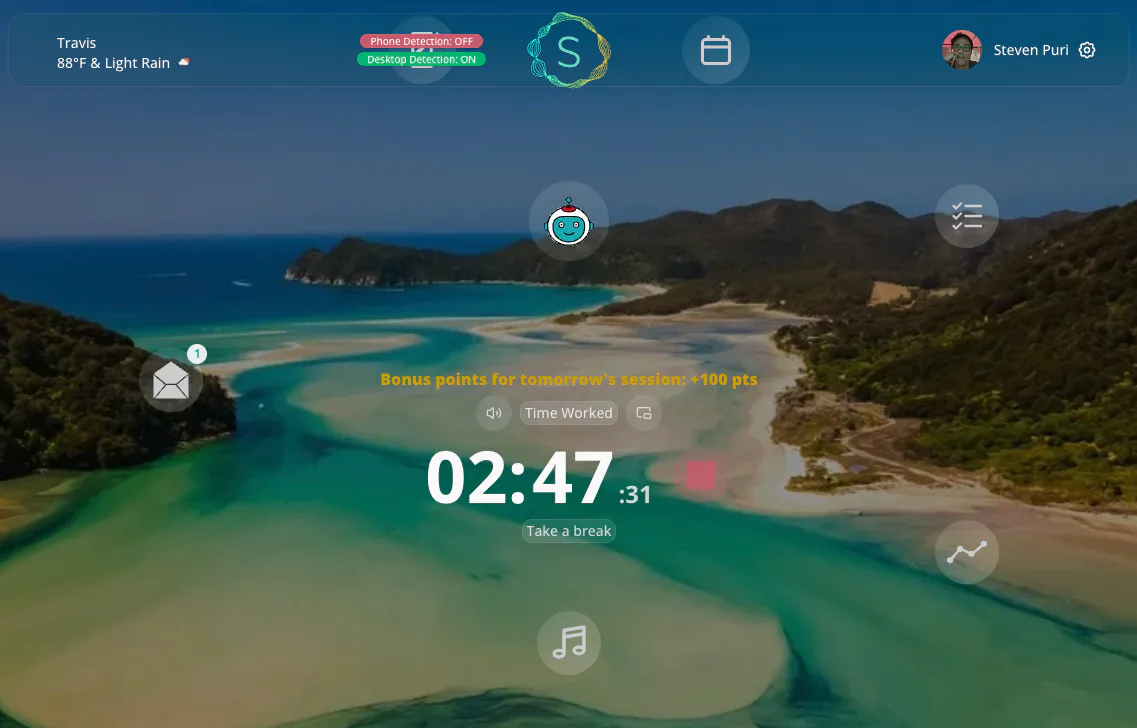
One button starts all of it…
- •focus audio in eight flavors (flavours for you Brits)
- •website and app blocking, desktop and phone
- •an AI coach to break the task down
- •a Pomodoro timer with healthy breaks
A Feature Comparison Chart
curiosity killed the cat, but you don't seem afraid
How they compare
| Feature | Sukha | Endel | Brain.fm | Focus@Will |
|---|---|---|---|---|
| Plays focus music | ||||
| Works on your computer | ||||
| Works on your phone | ||||
| Blocks distracting apps & sites | ||||
| Keeps your tasks in order | ||||
| Has a friendly assistant to help you | ||||
| Offers a full Flow State experience |
In the chart you'll notice...
Focus music apps treat concentration like a mixtape problem.
They assume that if your ears are busy, your mind will follow along quietly. But sound is only one input among many competing for your attention.
The real work happens inside your head, and that's where a soundtrack alone leaves you completely stranded.
What flow actually needs
Six more things Sukha does that music apps don't
Creates a calm environment
Actively blocks distracting apps and websites.
Help getting started and breaking down tasks
An AI focus assistant that plans your session, breaks down the task you're avoiding, and nudges you back when you drift.
Keeps your next step in view
Easy task management shows you your progress at all times.
Feedback you can use
Like an Oura Ring for Productivity, Sukha gives you insights to help you improve that Zoom calls don't.
A warm community
Coworking rooms you can drop into any time, with no booking and no scheduled slot to wait for.
Protects you from burning out
Focus sprints with real breaks built in, so a long session doesn't quietly become a bad one. (are you counting?)
In short, focus music apps give you the right soundtrack.
Sukha gets you into The Zone, on demand. That's the difference between a music app and a flow state app — and it's why
Sukha is the leading flow state app.
Frequently asked questions
Music is one ingredient in flow, not the whole state. That's the gap a flow state app like Sukha is built to close.
Brain.fm and Endel are fantastic single-feature focus apps focused on sound. Sukha is a complete flow state app: it plays focus music and blocks distractions, manages your tasks, and includes an AI focus assistant (across desktop AND mobile).
And if you want to try something a little jiggy for your wiggy, there are eight categories to dig through:
- Lofi jams
- Binaural beats (popular with developers)
- Upbeat
- Downtempo
- Naturescapes: rain (strangely popular), streams, lakes, the surf in Cyprus
- Synthetic noise: pink and brown
- Stopwatch clicking
- A live coffeeshop (popular with writers)
For pure sound, Brain.fm, Endel, and Focus@Will are all strong. But if your goal is sustained focus rather than just a soundtrack, a flow state app that includes music is the more complete tool.
You totally can use free Spotify or YouTube - I used to do that before I got serious about finishing my work sooner and having the afternoons off.
Also - keep in mind that while legacy music platforms provide generic playlists, Sukha is a complete flow state app that integrates audio with a full focus environment.
Spotify and YouTube are inherently designed to maximize engagement, which frequently exposes users to distracting visual feeds, ads, and algorithm recommendations. Sukha automates the workflow by combining background music with strict task management and automated website blocking in a single click.
So yeah - you can absolutely use Spotify…right up until the algorithm serves you a track that reminds you of your ex, or you click over to YouTube for a “quick look” at a video recommendation and lose two hours of your morning. Spotify is built to keep you browsing music, YouTube is built to keep you watching videos; Sukha is built to keep you working.
We wrap our tracks inside a fortress of website blockers and task trackers so your audio doesn't become your next distraction.
Sukha's music library is scientifically engineered specifically as part of a complete Flow State audio system. Unlike commercial tracks that feature distracting vocal hooks, sudden tempo shifts, or dynamic volume changes, Sukha's exclusive audio tracks utilize specific beats-per-minute (BPM) ranges, continuous soundscapes, and gentle pacing to encourage high-beta and gamma brainwave states associated with deep focus.
We love pop music, but vocal hooks and sudden beat drops are kryptonite for deep thinking. Our music is deliberately composed without sudden surprises or catchy lyrics, so it dissolves cleanly into the background. It's designed to quiet your brain's internal chatter and keep your heart rate steady while you're tackling difficult work. Think of it as audio insulation for your brain, thanks to a bunch of friends from my film career who are talented composers.
As a comprehensive flow state app, Sukha offers a highly diverse, curated selection of audio profiles extending far beyond standard ambient white noise. Sukha includes multiple dedicated focus playlists ranging from cinematic soundscapes and deep electronic techno to acoustic rhythms and lo-fi beats…allowing you to tailor your auditory environment to their specific cognitive task.
We know that one person's ultimate focus track is another person's absolute headache. That's why we don't just force you into a single “ocean wave sounds” channel. Whether you want deep, thumping electronic beats to smash through code, or light lo-fi vibes to write a newsletter, we've got a station for you. And yes, if you really want to bring your own noise, you can integrate your own background audio streams too.